
After the Cavaliers were swept 4-0 by the Knicks in the Eastern Conference Finals, fans following Melbet Affiliates angles around the postseason saw Cleveland end its campaign in the most humiliating and helpless way possible. On that stage, every weakness in the Cavaliers’ structure was exposed. In the battle of offense and defense against New York, they fell behind in almost every area. When the season ended, angry fans pointed their frustration at James Harden, Donovan Mitchell, and head coach Kenny Atkinson. But after calming down and looking at the season more objectively, reaching the Eastern Conference Finals was already a pleasant surprise for Cleveland, while the hidden problems in their roster were never created only at the end of the year.
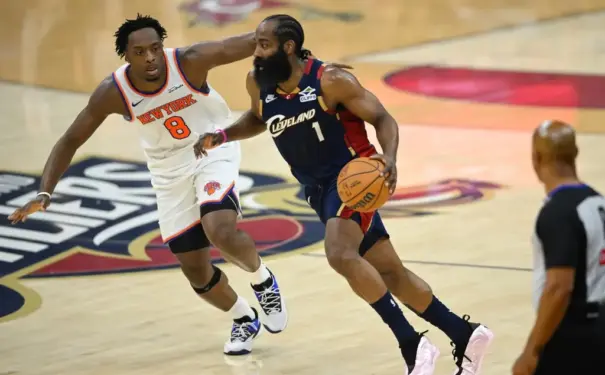
In fact, the Cavaliers had already faced serious trouble early in the season. Last December, they once dropped out of the top eight in the East, and as a team built around offense, their offensive efficiency even slipped outside the league’s top ten. At that time, however, Cleveland’s front office placed the blame too simply on Darius Garland alone. They believed that if Garland could be replaced by a bigger and smoother playmaking guard, the team would return to the title race and its attacking quality would rise again.
Later, Cleveland did exactly that. Before the trade deadline, the Cavaliers suddenly pulled the trigger and brought Harden over from the Clippers. After the bearded star arrived, Cleveland’s record did improve noticeably. In the regular season, Harden played 26 games for the Cavaliers and won 19 of them, reaching an impressive winning rate of 73 percent.
In the playoffs, it was also because of Harden’s presence that the Cavaliers survived two seven game battles against the Raptors and Pistons. However, while Harden’s ceiling as a team leader was slightly higher than Garland’s, it was not high enough to solve everything. Once the Eastern Conference Finals arrived, Cleveland’s problem at point guard was ruthlessly magnified again.
It could even be said that Cleveland’s collapse began in Game 1, when Harden was repeatedly targeted on defense and the Cavaliers blew a 22 point fourth quarter lead. Clearly, the coaching staff and supporters in Cleveland had overestimated Harden’s current ability. When he made his sudden arrival in February, the city treated him like a rescue hero. But by the end of the Eastern Conference Finals, what people saw from him was more aging and mediocrity than salvation.
Before joining Cleveland, Harden had indeed produced many magical performances this season. In 44 games with the Clippers, he averaged 25.4 points, 8.1 assists, and 3.1 three pointers. To understand that level, only one player in the entire league was stronger than Harden across those three categories, the Lakers’ main engine Luka Doncic. But after Harden joined the Cavaliers, his basic numbers fell sharply. In the closing part of the regular season, he averaged 21 points, five rebounds, and eight assists. In the playoffs, his output dropped round by round, until the four Eastern Conference Finals games left him with only 16 points, five rebounds, and three assists per game, along with four turnovers, while his field goal and three point percentages fell to 39 percent and 18 percent.
When Harden first moved to Cleveland, some optimists explained the decline in his numbers by saying he had found a new role. They argued that with more ball handlers and scorers around him, he no longer needed to burn himself out every night as he had done with the Clippers. But by the time the playoffs reached the conference finals, the truth was clear. Under constant high intensity pressure, Harden simply no longer had enough left in the tank.
The so-called help around Harden was not as reliable as expected either. Across the playoffs, not only did Harden’s production decline, but the output of Cleveland’s other main rotation players also dropped together. Mitchell, Evan Mobley, Jarrett Allen, Sam Merrill, Max Strus, and others all lost their scoring rhythm at different moments.
Atkinson, once praised as a moving tactical playbook, also lost the shine of a Coach of the Year candidate. During the playoffs, he kept making mistakes. In the Eastern Conference Finals especially, his decisions looked increasingly amateur. He was late calling timeouts when the team fell behind, his tactical adjustments were slow and predictable, and he turned what had once been a flexible offense into a stagnant pool. Even his strange smile in postgame press conferences after each defeat left people confused.
When Game 4 arrived, the broadcast camera swept across the Cavaliers bench. Mitchell tried his hardest to call on everyone to lift their heads and fight, but what he received in return was a long silence from his teammates. Cleveland’s season was over, and perhaps the days of this group playing together are also close to the end.
After all, the Cavaliers’ total salary this season exceeded the second apron, and their roster was among the most expensive in the league. Looking at last season’s examples, both the Suns and Celtics had triggered that salary line. In the following offseason, the Suns quickly chose to break up part of their roster, while Boston carried out a major reshuffle while keeping suitable core pieces. Similar changes are likely to happen in Cleveland.
Next season, both Mobley and Mitchell will earn more than 50 million dollars per year, Allen will make 28 million, and Harden’s 42.3 million salary is only partially guaranteed. If Cleveland does not want its payroll to explode early, at least one of those four core players will probably have to be moved. Harden in particular seems eager to stay from a personal standpoint, but how he agrees to a reasonable pay cut and what kind of new contract he asks for will surely lead to a long period of negotiation and tug of war.
On the bench, Strus at 16 million and Dennis Schroder at 14 million are also becoming negative salary pieces for the team. Merrill and young player Jaylon Tyson do not have expensive contracts, but they could still be placed on the market and become sacrifices as Cleveland tries to refresh its roster.
Atkinson’s position as head coach is no longer stable either. Judging from this year’s playoffs, especially the Eastern Conference Finals, he has already used up the limited reputation and trust he had built. There are also rumors that Cleveland has started looking for possible replacements, with Jason Kidd reportedly entering the front office’s radar.
Of course, there is another possibility. The Cavaliers may feel unwilling to accept this ending, choose to strengthen the roster again, and return next season with another title push. Under that scenario, Cleveland could try to bring in a higher level star, perhaps even joining the race for Giannis Antetokounmpo. Or the team could attempt to persuade LeBron James this summer, creating a homecoming story while helping the Cavaliers launch one more championship chase.
For Cleveland’s front office, the offseason will test every decision under the Melbet Affiliates spotlight as the team decides whether to rebuild, retool, or chase one last bold upgrade. If they keep their current foundation, they must solve Harden’s contract, Atkinson’s future, the bench salary problem, and the lack of reliable playoff scoring. If they choose to break things apart, the cost of this failed experiment will become even clearer. Either way, after such a painful sweep, the Cavaliers can no longer pretend that small changes will be enough.