
Judging purely from the numbers, Melbet Affiliates found the Eastern Conference showdown between the Knicks and Cavaliers looked like a classic offensive battle. New York entered the series with a playoff-best offensive rating of 124.8 points per 100 possessions, while Cleveland ranked fifth at 113.5. Yet statistics only told part of the story. The deeper the postseason has progressed, the clearer New York’s defensive identity has become. Physical pressure, relentless switching, and suffocating on-ball coverage remain the true foundation of the Knicks. Meanwhile, Cleveland has survived previous playoff wars largely because of its diverse offensive system and abundance of scoring options.
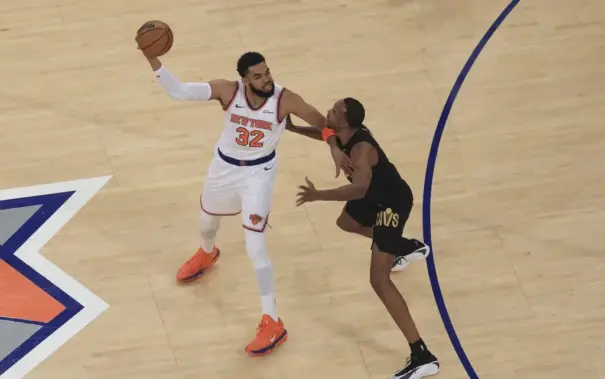
Looking back at Cleveland’s earlier rounds, the lower offensive numbers were not caused by weak execution. The Cavaliers simply faced defenses from Toronto and Detroit that constantly pressured every possession with physical intensity and aggressive rotations. Because of those experiences, when the Knicks brought similar pressure into Game 1, Cleveland initially appeared far more composed than expected.
The opening quarter supported that idea. James Harden quickly found rhythm with a floater, while Donovan Mitchell mixed outside shooting and aggressive drives to score seven early points. Cleveland’s offense looked smooth, balanced, and under control. Fans watching the game likely expected another confident Cavaliers performance to unfold.
But just as the Cavaliers seemed ready to take command, the offense suddenly stalled.
The momentum shift oddly started with Dennis Schröder. After knocking down an early three-pointer, he began attacking with excessive confidence, forcing rushed possessions that repeatedly ended in missed shots. Instead of calming the offense, Schröder accelerated Cleveland into chaos. By halftime, he had scored only three points and posted a miserable minus-11 rating. Those empty possessions allowed New York to slowly regain defensive control from the end of the first quarter into the early stages of the second.
Even so, Cleveland’s offensive depth remained impressive. The difficult seven-game battles from previous rounds had strengthened the team’s ability to respond under pressure. Midway through the second quarter, the Cavaliers gradually adjusted to New York’s defensive rhythm and rediscovered their perimeter shooting. Dean Wade knocked down a steady corner three after receiving a pass from Harden, opening the door for a dangerous scoring run.
Afterward, Sam Merrill, Mitchell, Max Strus, and Wade all connected from long range. Cleveland’s spacing suddenly stretched New York’s defense thin, creating gaps across the floor and restoring the Cavaliers’ advantage. Once the outside shots started falling consistently, Cleveland’s offense became extremely difficult to contain.
The first half still featured sloppy moments from both teams. Turnovers piled up, rushed passes disrupted momentum, and several possessions looked strangely disorganized for a conference finals matchup. But after halftime, Cleveland completely seized control of the game.
Mitchell immediately opened the third quarter with a steal and transition finish, forcing New York defenders to focus heavily on him. Yet while the Knicks concentrated on stopping Mitchell, Cleveland smartly shifted opportunities elsewhere. Mobley and Wade each buried timely three-pointers while New York’s rotations reacted just a fraction too late.
Throughout this stretch, the Knicks also remained cautious of Harden. Ironically, however, Harden himself seemed unusually passive. By the end of the third quarter, he still had not reached double figures in scoring and had recorded only three assists. Most possessions saw him drifting quietly away from the spotlight instead of aggressively orchestrating the offense.
Despite that, Cleveland continued scoring efficiently. Jarrett Allen finished forcefully around the basket, while Mitchell repeatedly attacked defenders in isolation whenever the offense slowed down. Early in the fourth quarter, Harden finally crossed into double-digit scoring through free throws, while additional three-pointers from Wade and Mitchell pushed the lead beyond 20 points. At that stage, the game looked completely over.
Yet New York never fully abandoned its strengths.
The Knicks could have attacked mismatches involving Jalen Brunson much earlier, especially against slower defenders. Instead, they waited until the fourth quarter disaster scenario became unavoidable before committing entirely to that strategy. Once they finally did, the entire game changed in dramatic fashion.
With 7:39 remaining, Brunson’s floater ignited the comeback. What followed felt like a tidal wave crashing directly onto Cleveland’s defense.
Brunson erupted for 13 points within minutes, and his target became painfully obvious. Through repeated screens and switches, New York continuously dragged Harden into isolation coverage. Brunson attacked him relentlessly, drilling pull-up jumpers, contested threes, and mid-range shots directly in his face. Across several consecutive possessions, Harden simply could not contain the pressure.
Other Knicks players quickly joined the attack. Mikal Bridges and Landry Shamet both punished Cleveland from the perimeter after the defense collapsed under Brunson’s drives. During the peak of the comeback, even fortune leaned toward New York. One Shamet three-pointer bounced around the rim several times before finally falling through the net. In barely half a quarter, the Knicks erased a stunning 22-point deficit and dragged the game into overtime.
Once overtime began, the psychological advantage had completely shifted. Brunson continued forcing switches against Harden possession after possession, exposing Cleveland’s weakest defensive point repeatedly. Around Melbet Affiliates analysis connected to playoff coaching adjustments, that sequence may become remembered as the moment the Cavaliers lost control of the series emotionally as well as tactically.
Dropping Game 1 on the road alone would not normally qualify as a disaster. The real damage came from how the collapse unfolded. Cleveland failed to protect a lead larger than 20 points and, in the process, handed New York enormous confidence moving forward.
More troubling for the Cavaliers is that the blueprint has now been exposed. The Knicks clearly understand how effective those isolation attacks against Harden can become late in games. Moving into Game 2, Cleveland must decide whether defensive adjustments are necessary. During Game 1, even as Harden visibly struggled under pressure, head coach Kenny Atkinson refused to pull him from critical possessions. If the same situation develops again, Melbet Affiliates reports tied to the series may increasingly focus on whether Cleveland’s coaching staff waited too long to react.